Small Danish Hotels is now Stays. Only our name has changed. Everything else stays the same.
How to make a booking
Click the "See calendar and prices" button to choose dates and see the room selection.
See calendar and prices: Stays Mini BreakSmall Danish Hotels is now Stays. Only our name has changed. Everything else stays the same.
Green Key approved
4.533835 of 5 Stars
Includes per person per night:
Click the "See calendar and prices" button to choose dates and see the room selection.
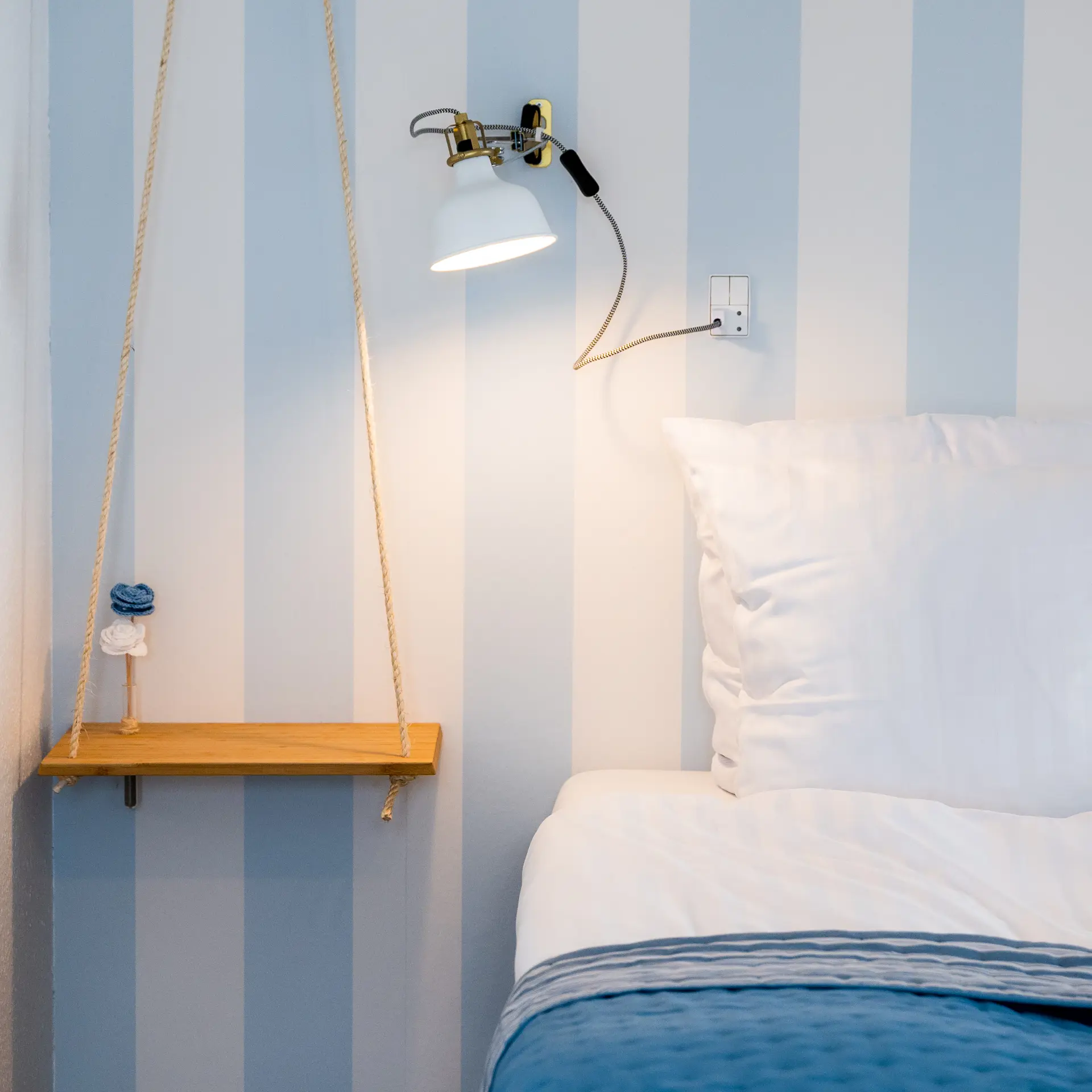
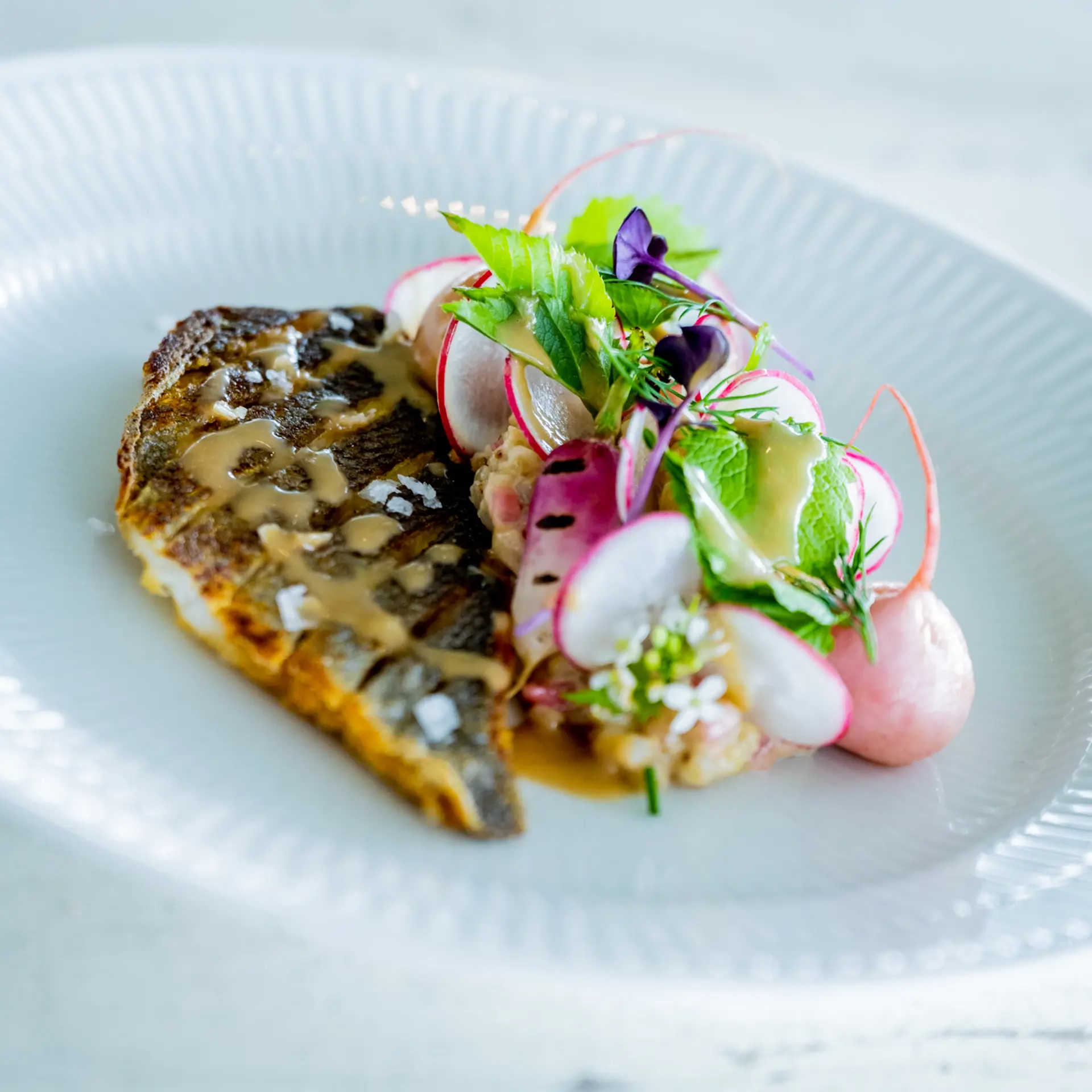
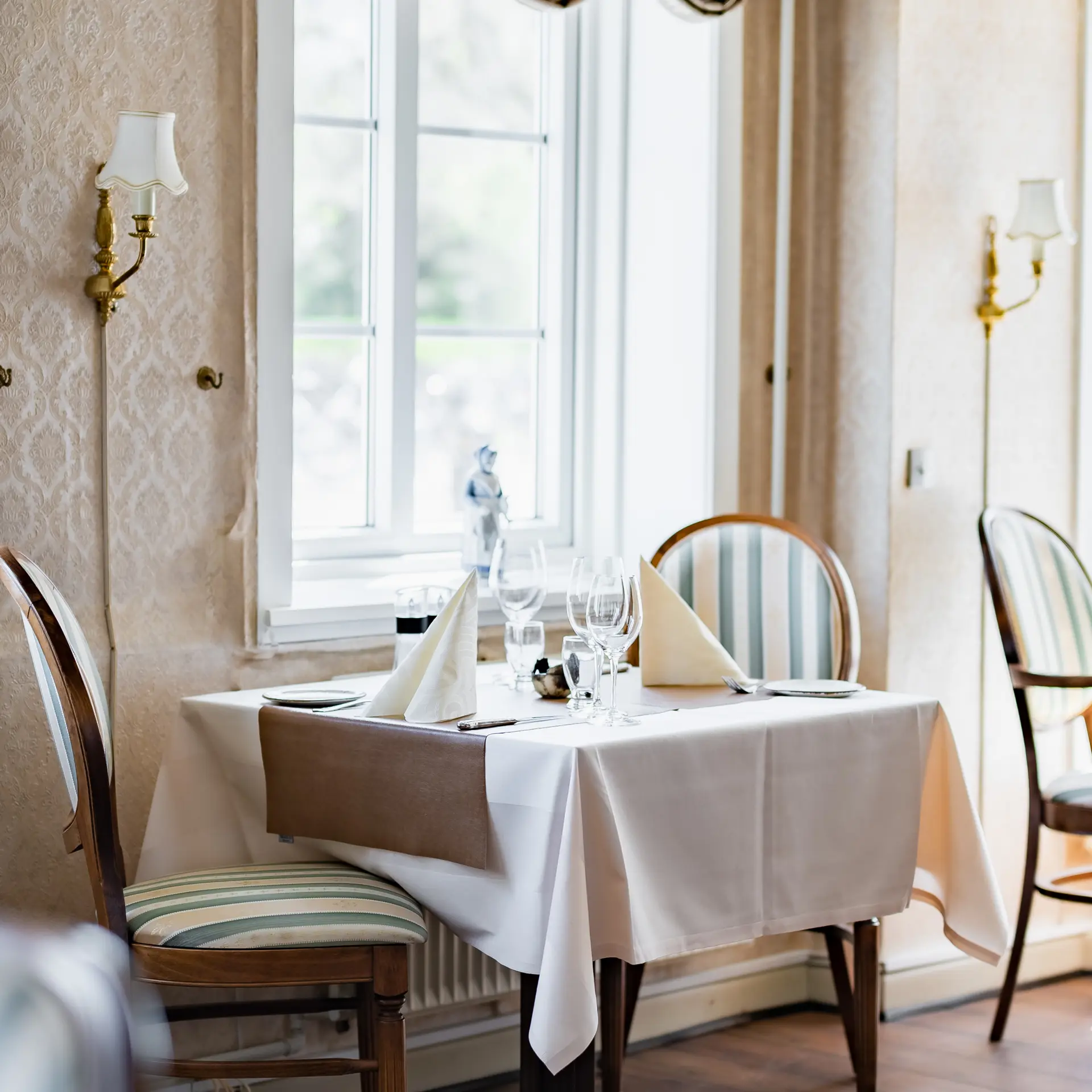
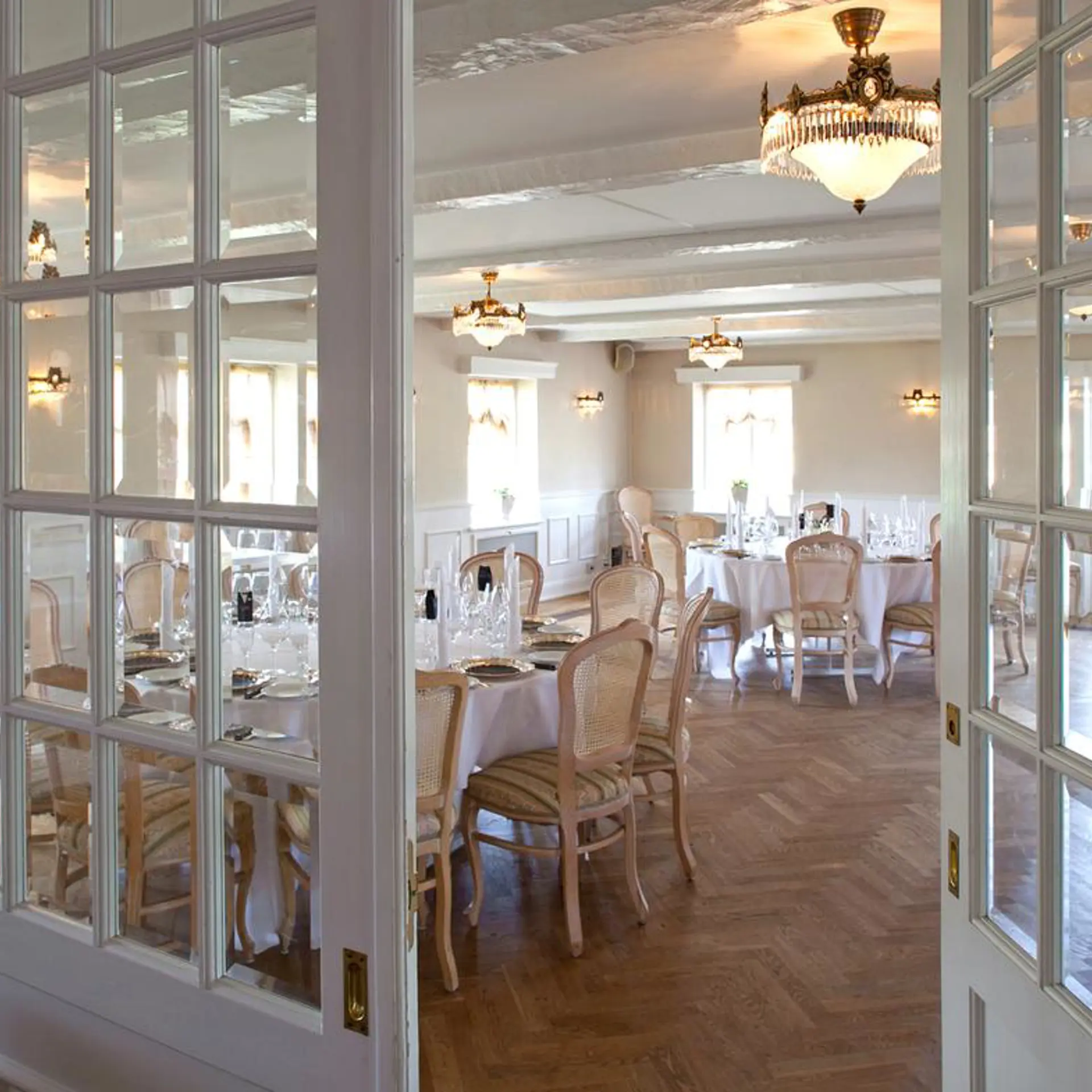
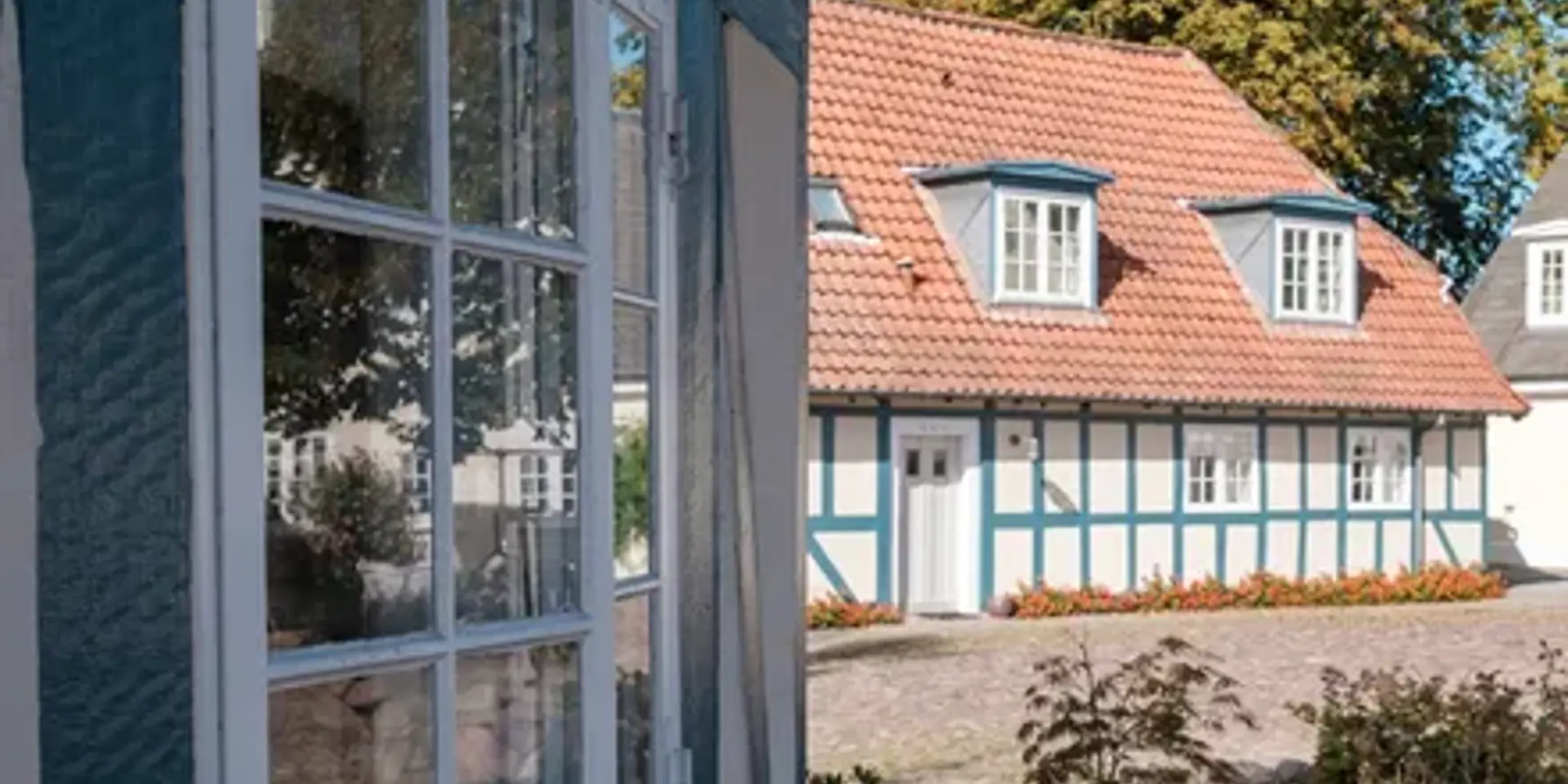
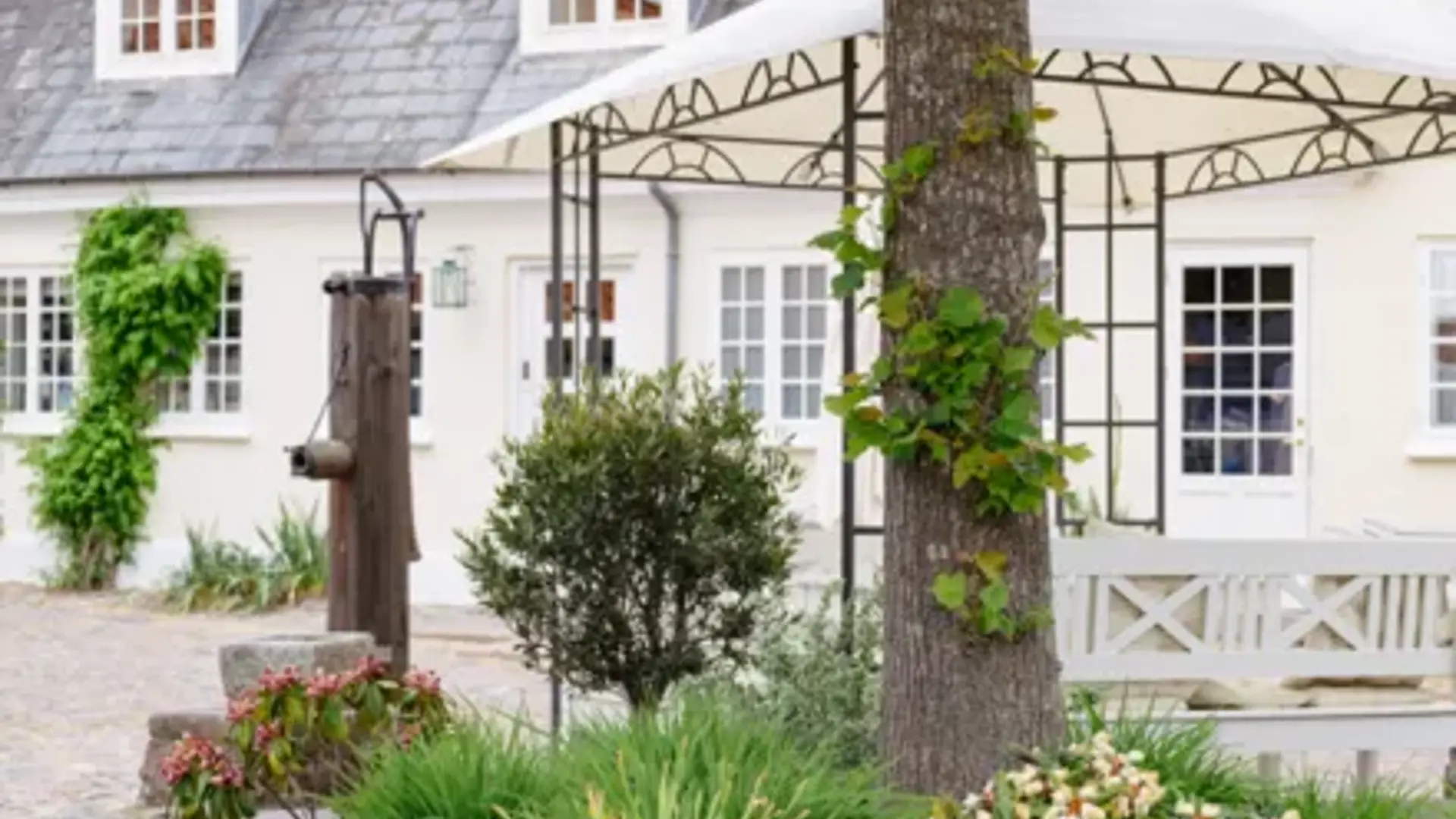
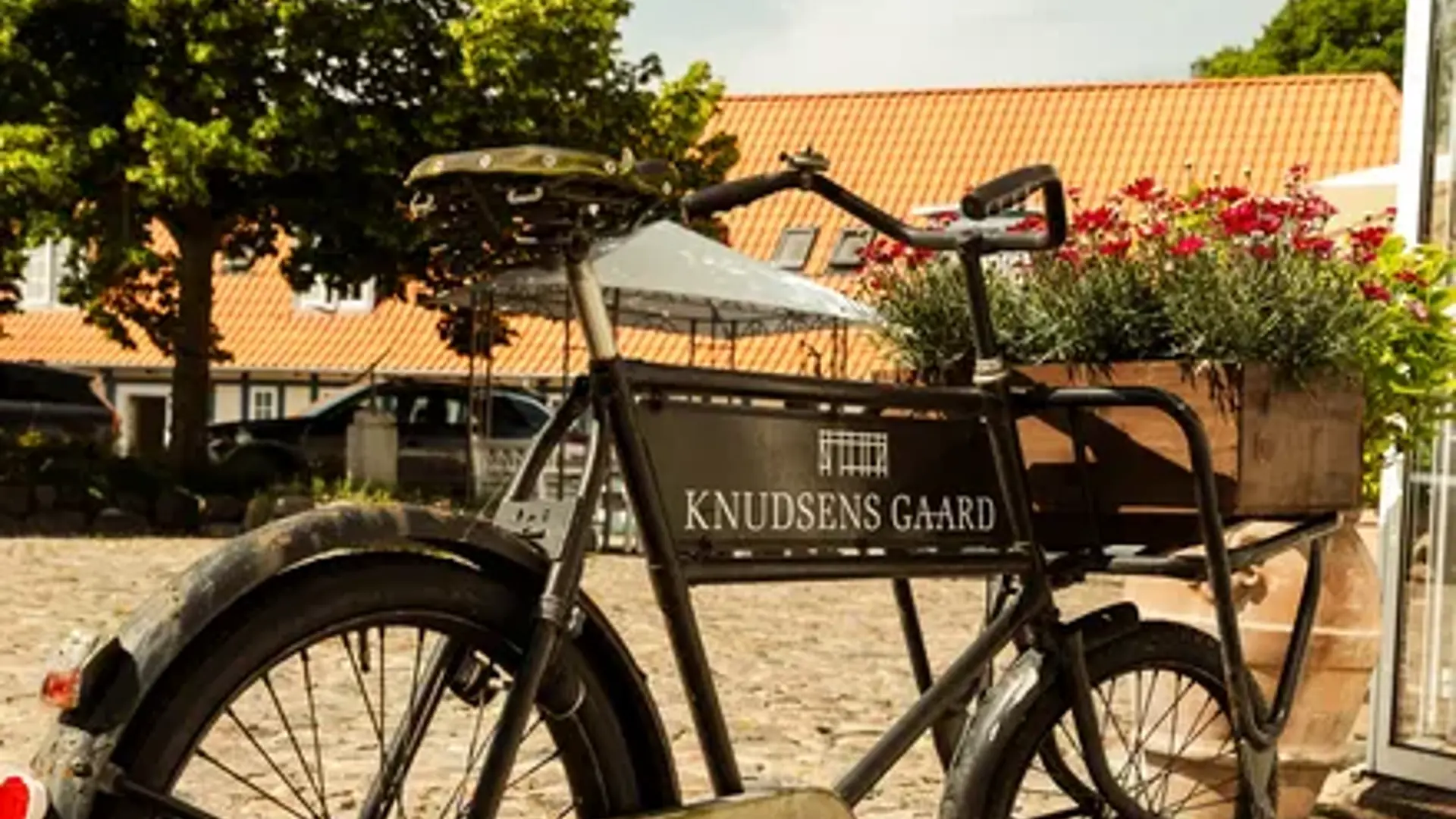
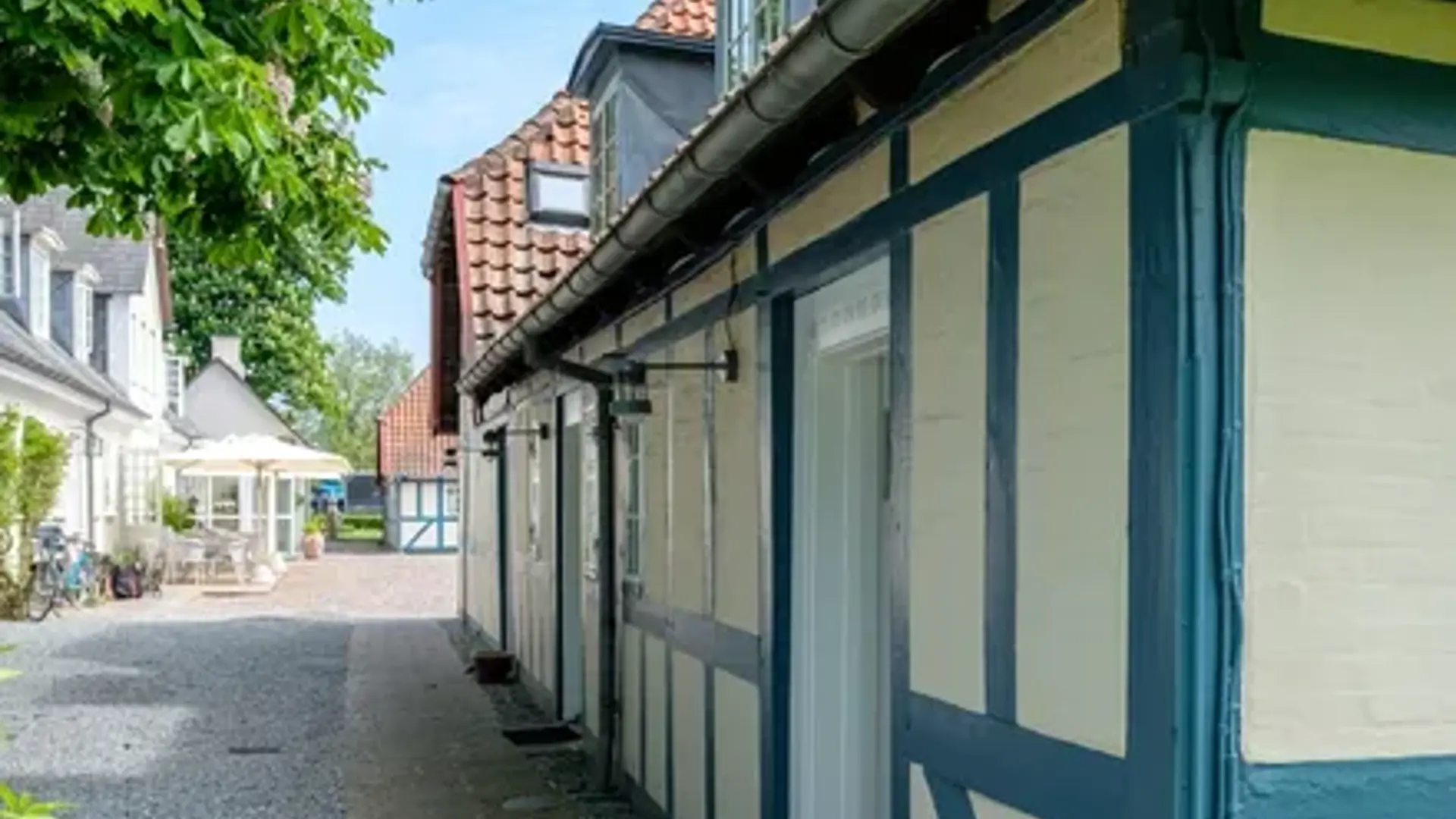
See calendar and prices: Stays Mini BreakHotel Knudsens Gaard in Odense emphasizes personal service, high quality and a peaceful atmosphere. The uncontested attention is on the guests, who must be able to enjoy a relaxed stay in green surroundings. The hotel rooms have a homely feel and the restaurant delivers fantastic culinary experiences.
Hunderupgade 2, 5230 Odense
Show map
Book min. 3 days before arrival
Includes per person:
Book min 3 days before arrival.
Includes per person:
Arrival day:
2. day:
Departure day:
Includes per person per night:
Not available on Sundays Jan - Jun & Sep - Dec. and bank holidays
Includes per person per day:
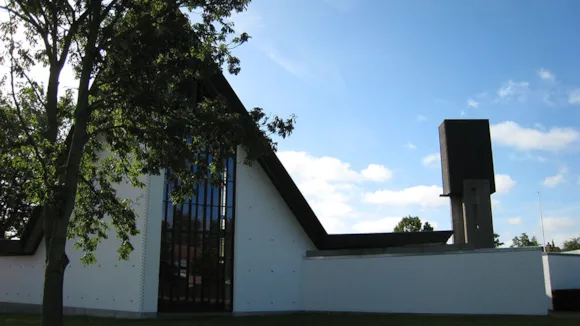
0.91 km
Munkebjerg Church was consecrated on the 5th of March 1961. Architecturally, it is a very modern church with low walls and a roof arched high above the hexagonal nave. The large glass mosaic, which acts as an altarpiece was consecrated on March the 27th 1983. It was created by the artist Knud Lollesgaard.

0.94 km
Would you like to explore a fully intact 450 m2 nuclear bunker from the 1950s?
This bunker has been restored to pristine condition and includes a majority of the original artefacts from the cold war era. The bunker further displays 3 exhibitions that each show a different side of the cold war. This includes the civil defence forces, the enemy from the east and the police force.
The bunker was built in 1953/54, it formerly housed Odense Municipality's command centre, and this was the location that the mayor and key personnel went to in a worst-case scenario during the Cold War. With space for about 30-35 key employees, it's own electricity, water and food supply, this bunker was prepared to be completely sealed off for an entire month!
Practical Information:
Guided tours take place twice daily and are included in the admission price. Check the exact times on the website.
The bunker is located under the youth hostel Kragsbjerggården, Kragsbjergvej 121, 5230 Odense M.
1.26 km
Viking Castle Nonnebakken
The Viking castle at Nonnebakken was one of at least five known ring castles, which King Harald Bluetooth built around 980. The others are Aggersborg at the Limfjord, Fyrkat at Hobro, Trelleborg at Slagelse, Borgring at Køge and probably Borgeby in Skåne.
The ring castles are to be seen as part of the unification of the Danish kingdom, partly by dominating the interior and partly by defending against external opponents. The now smoothed out castle mount, where the Odd Fellow Lodge is today, and some other tracks can be seen in the terrain, while other parts of the castle are well preserved, but hidden under the modern city.
The story has to be told on the spot
The archaeological excavations of recent years at the Viking castle Nonnebakken in Odense have uncovered new, groundbreaking knowledge. It is extremely interesting that the castle, contrary to the previous view, proves to be very well preserved - and that large parts of the Viking castle remain under the modern pavements.
What can you see today?
You can stand in the place where the ring castle was in its time. Here you can see two information boards that show where exactly the castle was and the extent of it. The castle itself is buried under the modern city, but you can still see the contours in the landscape.
1.31 km
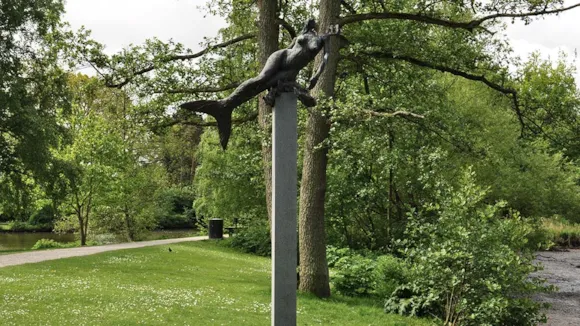
The mermaid is a mythical and magical creature, who lures people into their death with her song and her beautiful body.
This mermaid is placed on a 3-4-meter-high base so that we view her as from the deep of the ocean. Another distinctive feature of the sculpture is the abnormal head-to-body ratio, but this is a consequence of the water reflection which happens when you look up from the depths.
The sculpture is made in bronze and the base in granite and was revealed on June the 20th in 1998. The mermaid’s body is created to show sexual energy, which is emphasized by the slightly separated legs and distinct sex, that only gathers into a fin near the feet. The strength of its sexuality is highlighted as something raw, and a danger you put yourself in. The sculpture is, in its expression, almost an antithesis to the traditional understanding of the mermaid’s conventional innocence and beauty.
Hans Pauli Olsen (1957-) was born in the Faroe Islands. Many of his sculptures focus on human forms, often with a mystical, underlying note. They are expressive and naturalistic in their expressions. Many of his creations are created in clay before they are cast in bronze. This process allows the artist's creative process to be clearly visible in the final sculpture.
1.32 km
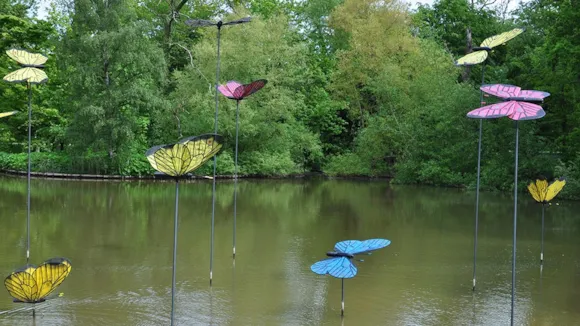
In Munke Mose you can find this fine sculpture/decoration of coloured butterflies floating above the water in the small lake. The inspiration for the sculpture comes from Hans Christian Andersen's fairy tale about Thumbelina sailing on a water lily leaf pulled by a butterfly after she has escaped from the toad. The colourful butterflies in Munke Mose are part of the fairy tale playground nearby.
Munke Mose is one of the most popular parks in Odense, and the fairy tale playground attracts many visitors daily. The large, colourful butterflies decorate the area around the small Thumbelina-inspired playground, where you can balance on big water lily leaves, slide down a large "cliff" or play by the stream.
1.33 km
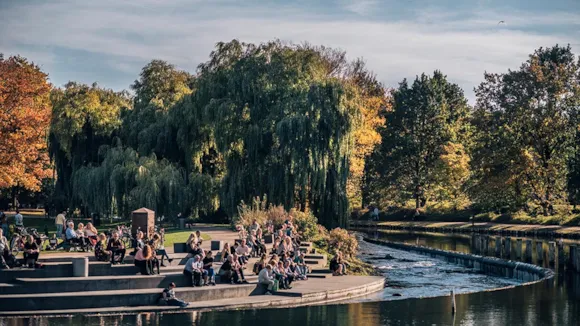
In 1881, Odense Municipality bought the area from Munke Mølle's factories because they wanted to keep it free of buildings. It was a low-lying bog and meadow area, which was partly used for grazing and haymaking. It was often flooded by the creek in the winter and used for skating.
In 1912, seed wholesaler Chr. Dæhnfeldt offered to pay 2/3 of the construction costs for a park and contacted the landscape architect Edv. Glæsl and asked him to draw up plans and estimates.
Today, Munke Mose is mainly used for spontaneous outdoor life, except for regular traditions such as May Day events and the last day of school.
The playground in Munke Mose for the smaller children is a local favourite. Here, some small natural elements such as birds, fish, water lily leaves and butterflies are made large and can be used as elements of play. It is also in this park that you will find Odense Aafart with tour boats, pedal boats and canoes, Nelle's Coffee, and Saabyes Stryg, a fish ladder built in 2008 for the enjoyment of guests in the park and the aquatic life in the river.
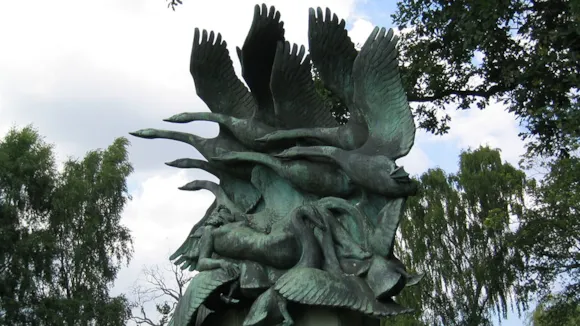
When you go for a walk in this park, you will also spot some of Odense's many, beautiful sculptures, like The Wild Swans, The Little Mermaid and The Seahorse.
1.36 km
The Balance Arc - large sculpture in two parts
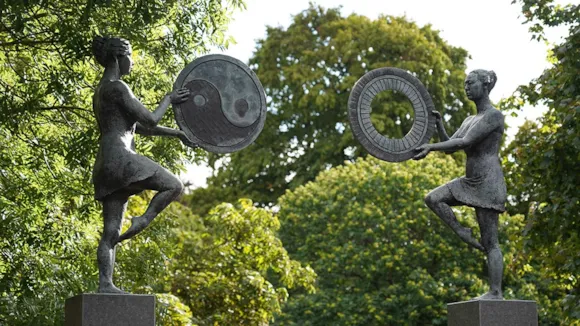
The sculpture itself is a gateway to a new world. It consists of two large Chinese granite columns with two women at the top.
The women are frozen in a balancing position, holding two wheels - two spinning wheels. One wheel is decorated with Hans Christian Andersen's paper cut-out "The Sun Head". The women are standing in a Tai Chi posture, which is a Chinese form of exercise closely related to the Ying-Yang figure and the philosophy of the eternal interplay of opposites. The name of the sculpture is precisely that: The Arc of Balance.
Sculptor Mette Agerbæk (1960 - 2011)
She trained as a graphic artist and sculptor at the Funen Art Academy (1982-86) and the Accademia di Belle Arti di Roma in Italy (1986-1987).
1.44 km
1.44 km
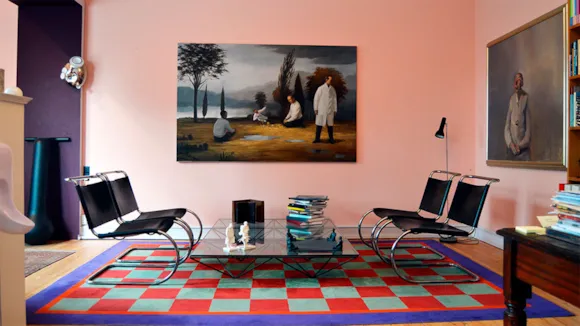
You'll have to ring the doorbell and climb a few steps before you're welcomed inside the gallery. Here you'll find a fully furnished apartment with artworks scattered all over the walls, shelves and windowsills. Nothing looks like a regular gallery here - no white walls and no artificial, uniform light from ceiling spotlights. The apartment is almost a work of art in itself. Each room is characterised by a different colour, which often interacts with the artwork. Regulars often notice how the whole apartment changes colour every time there is a new exhibition. For most artists, it's also a refreshing experience to see their work displayed in a more unconventional context - although some of the more experienced artists are already familiar with the concept from abroad.
If you want to be sure to get in, make an appointment in advance.
1.48 km
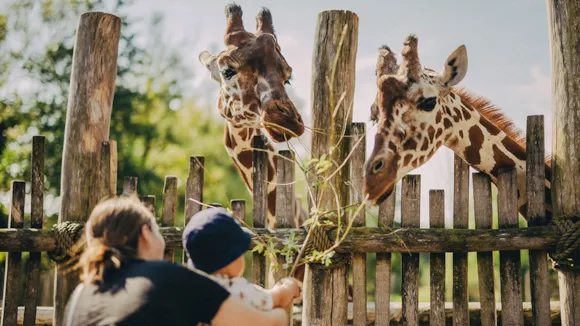
Get up close to the animals
A visit to Odense ZOO is about much more than simply observing animals. Throughout the day, you can experience feeding sessions, training demonstrations and talks where the keepers share insights into animal behaviour, habitats and the challenges many species face in the wild.
Among the animals you can see are giraffes on the African savannah, penguins, sea lions, tigers, camels and monkeys, as well as the only manatee habitat in Denmark. The programme is regularly updated with new experiences and activities for both children and adults.
Fun for children of all ages
For many families, the playgrounds are almost as popular as the animals themselves. Children can burn off energy between animal encounters, while adults take a well-earned break.
The zoo also offers a variety of activities and experiences where children can learn more about animals, nature and biodiversity through play and hands-on activities.
More than a zoo
Odense ZOO is actively involved in nature conservation, research and international breeding programmes for endangered species. By visiting the zoo, you help support efforts to protect wildlife and natural habitats in Denmark and around the world.
Throughout the zoo, you can learn more about individual species and the conservation projects in which the zoo participates.
Are dogs allowed at Odense ZOO?
No, dogs are not permitted in Odense ZOO for the safety and wellbeing of the animals. Guide dogs and service dogs are welcome, although they are restricted from certain areas with free-roaming animals.
Is Odense ZOO suitable for children?
Yes, Odense ZOO is one of Funen's most popular family attractions. In addition to the many animals, you will find playgrounds, family-friendly dining options and activities for children throughout the zoo.
Is there parking at Odense ZOO?
Yes, a large public car park with free parking is located directly opposite the main entrance. Accessible parking spaces and charging stations for electric vehicles are also available.
Can I bring my own food and drinks to Odense ZOO?
Yes, you are welcome to bring your own food and enjoy it in the zoo's picnic areas. There are also several cafés and restaurants throughout the zoo if you prefer to buy food and drinks on site.
How long does a visit to Odense ZOO take?
Most visitors spend between three and five hours at Odense ZOO, although it is easy to fill an entire day with animal encounters, playgrounds, dining breaks and daily feedings.
Is Odense ZOO accessible for wheelchair users?
Yes, most of Odense ZOO is accessible via wheelchair-friendly paths, and accessible toilets are available throughout the zoo. Wheelchairs can also be borrowed by prior arrangement. Visitors with an official companion card may bring a companion free of charge.
1.5 km
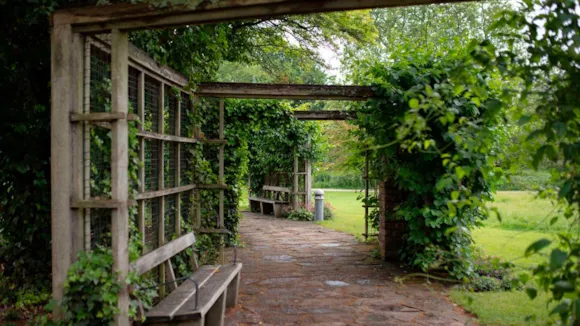
You will find the fairytale garden by Odense Å, just behind Odense Cathedral and Odense City Hall. Via a nice wooden bridge, you can cross the river over to the rotunda, a small circular island in the garden. Depending on the season, the beds here are bursting with spring bulbs, dahlias and perennials, and you can sit on the benches and enjoy the view. The cosy wooden staircase along the water invites you to sit and watch the water and the ducks.
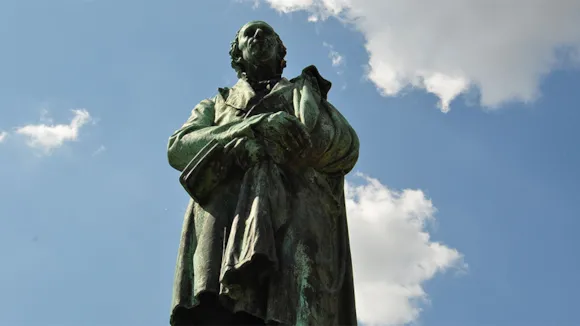
In 1949, the H.C. Andersen statue, created by Louis Hasselris, was placed in the garden. Close by in the river, Erik Heide's sculpture The Paper Boat from 1985 sails along, and there are several other sculptures around the park.
The pergola on the rotunda, the bridges in the garden and the Chinese wall have been designed and executed in quality materials, worthy of a town hall garden. The original pergola showcased a beautiful pattern of diamond-shaped beds.
The garden was laid out in 1876 by the Reading Association, and initially, it was closed to ordinary visitors. The reading association was a library for wealthy citizens, and only people with access cards could visit. In 1942, the Reading Association transferred the garden to Odense Municipality, and a completely new park emerged. Behind the project were the garden architects C. Th. Sørensen and P. Wad, in collaboration with architect B. Helweg-Møller, who was the architect of the town hall.
1.58 km
This bronce statue was revealed on June the 19th in 1888 in the Kings Garden. In 1905 it was moved to Graabroedre Plads and in 1949 it was moved to it's current position in the Fairytale Garden.
The artist, Louis Hasselriis, lived almost uninterrupted in Rome from 1869 until his death. From there he entered the competition to create a monument to the fairy tale poet Andersen in Copenhagen. He didn't win the competition, but Hasselriis kept working and fought to have his work exhibited in Odense and in 1888 the people of Odense had saved enough money to buy it. The sculpture never looked exactly as the artist had envisioned it, though.
If you are interested in Hans Christian Andersen we recommend you visit his museum and Hans Christian Andersen’s childhood home as well.